
You’ve probably heard both terms floating around. Generative AI. Agentic AI. They sound similar, and people often mix them up.
But they’re not the same thing.
If you’re making decisions for your business, this difference matters more than you might think. It affects how you invest, what you build, and how your teams work going forward.
So let’s clear it up in plain English.
First, what is Generative AI?
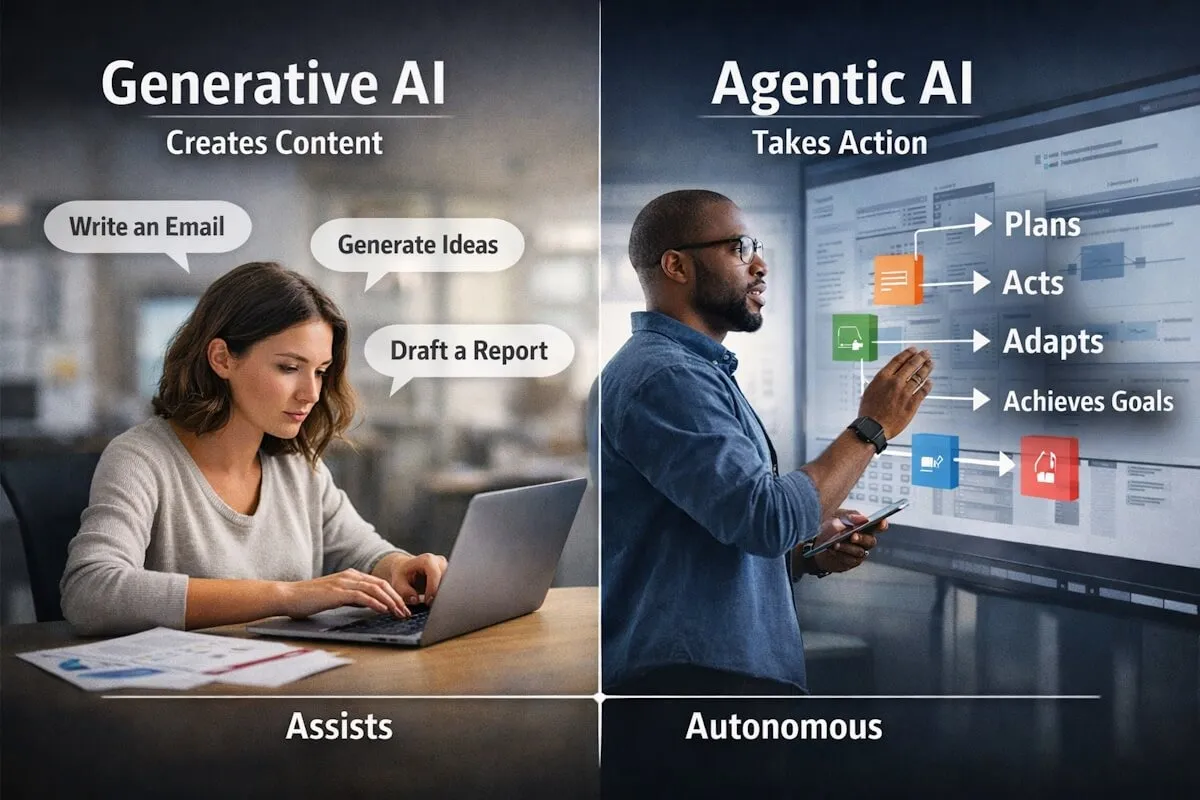
Generative AI is all about creating content.
Text, images, code, emails, product descriptions. You give it a prompt, it gives you an output.
That’s it.
It doesn’t take action on its own. It doesn’t decide what to do next unless you ask it.
Think of it like a very smart assistant who waits for instructions.
You say:
- “Write this email”
- “Summarize this report”
- “Generate ideas”
It responds. Then it stops.
It’s useful. No doubt. But it’s still reactive.
Now, what is Agentic AI?
Agentic AI works differently.
Instead of waiting for instructions every time, it operates based on a goal.
You tell it what you want to achieve, not how to do it.
And then it:
- Plans the steps
- Takes actions
- Adjusts based on outcomes
- Keeps going until the goal is met
It doesn’t just respond. It acts.
That’s the core difference.
The simplest way to understand it
Let’s make this real.
Imagine you run a sales team.
With generative AI:
You ask it to write outreach emails. It creates them. You send them manually.
With agentic AI:
You set a goal like “increase qualified leads.”
The system:
- Finds potential leads
- Crafts messages
- Sends them
- Tracks responses
- Follows up
- Adjusts messaging
All without you stepping in at every stage.
See the gap?
One helps you do the work. The other starts doing the work.
Why this difference matters for leaders
This isn’t just a technical distinction. It’s a business decision.
If you only focus on generative tools, you improve output. That’s good.
But if you start using agentic systems, you change how work happens entirely.
That’s a bigger shift.
It impacts:
- Team structure
- Cost of operations
- Speed of execution
- Customer experience
And honestly, it changes what your team even spends time on.
Where Generative AI fits best
Let’s not downplay it.
Generative AI is great for:
- Content creation
- Brainstorming ideas
- Drafting documents
- Supporting customer responses
- Writing code snippets
It saves time. It reduces effort. It helps your team move faster.
But it still needs direction.
Someone has to:
- Decide what to create
- Review outputs
- Take action afterward
It’s a helper, not a doer.
Where Agentic AI starts taking over
Agentic AI shines when there are repeatable processes.
Think about:
- Lead management
- Customer support flows
- Data monitoring
- Task execution across systems
These are areas where constant human involvement slows things down.
Agentic systems reduce that friction.
They don’t just assist. They handle.
And they keep learning from what works and what doesn’t.
The risk of misunderstanding this shift
A lot of leaders assume that adopting generative AI means they’re “ahead.”
Not really.
If your competitors start using agentic systems, they’ll:
- Move faster
- Handle more volume
- Respond quicker to changes
Meanwhile, you’ll still be relying on people to connect the dots between outputs and actions.
That gap adds up over time.
Why you shouldn’t treat them as competitors
Here’s a mistake many make.
They compare agentic AI and generative AI like one will replace the other.
That’s not how it works.
They actually complement each other.
Agentic systems often use generative capabilities inside them.
For example:
An agent might generate an email (generative) and then send it, track it, and follow up (agentic).
So it’s not about choosing one.
It’s about understanding how they work together.
What this means for your business strategy
If you’re planning ahead, you need to think in layers.
Start with:
- Where can generative AI improve output?
Then move to:
- Where can agentic AI take over execution?
This layered approach gives you better results.
Jumping straight into complex systems without clarity can create confusion. But ignoring agentic capabilities entirely? That slows you down.
Why many businesses struggle to adopt agentic systems
Let’s be real. This isn’t plug-and-play.
Agentic systems need:
- Clear goals
- Well-defined workflows
- Reliable system connections
- Continuous monitoring
Without this, things break or behave unpredictably.
That’s why many businesses hesitate.
They don’t want to risk messing up core operations.
The smarter way to move forward
You don’t have to figure everything out yourself.
Working with teams that specialize in Agentic AI Development Services can make this transition smoother.
Instead of experimenting blindly, you get systems designed around your processes.
That reduces trial and error.
And it gets you results faster.
Why the right developers make a difference
Here’s something people overlook.
Building agentic systems isn’t just about coding.
It’s about:
- Designing decision flows
- Structuring goals clearly
- Ensuring actions are reliable
- Handling edge cases
If this isn’t done right, the system won’t perform well.
When you Hire AI Agent Developers, you’re investing in people who understand how to balance autonomy with control.
That balance is what makes these systems useful instead of risky.
A quick side-by-side view
Let’s simplify everything.
Generative AI:
- Creates content
- Waits for prompts
- Needs human action after output
Agentic AI:
- Takes action
- Works toward goals
- Operates with minimal supervision
Both are useful. But they serve different purposes.
What leaders should focus on right now
You don’t need to adopt everything at once.
Start by asking:
- Where is your team spending too much time?
- Which tasks feel repetitive?
- Where do delays usually happen?
Use generative tools to speed up output.
Then explore agentic systems to reduce manual execution.
That’s a practical way forward.
The shift you can’t ignore
This isn’t a trend that fades.
It’s a shift in how work gets done.
Teams will rely less on step-by-step execution and more on goal-driven systems.
That means:
- Fewer bottlenecks
- Faster operations
- Better use of human time
And over time, that creates a clear gap between businesses that adapt and those that don’t.
Where do you stand?
You don’t have to rush.
But you do need to understand what’s coming.
Generative AI helps your team work faster.
Agentic AI helps your business run smarter.
And when you combine both, you’re not just improving processes. You’re changing how your business operates at its core.
So the real question is simple.
Are you just speeding up tasks, or are you rethinking how those tasks get done in the first place?